
#GaborMate #Gaza #CollectiveTrauma #Palestine #Israel #DoubleDownNews
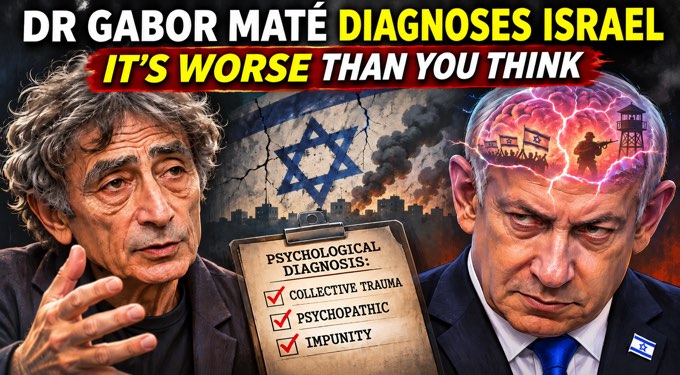
Some videos I share because they’re easy to watch. This isn’t one of them. Dr. Gabor Maté has spent his career showing how unhealed trauma shapes individual lives. In this interview with Double Down News, he applies that same lens to a whole nation, and what he finds is deeply uncomfortable.
Maté speaks as someone with a personal stake. He was born in Budapest in 1944, and his grandparents were murdered at Auschwitz when he was an infant. He says he and his mother could easily have died there too. He insists that this history gives him no special authority. What it does, he argues, is break the myth that Jewish suffering justifies what is being done to Palestinians, and the idea that any single leader or institution speaks for all Jews.
At the center of his argument is something he calls “a culture of entitled victimhood.” He compares it to the way people in a marriage cast themselves as the victim so they don’t have to look at their own behavior. According to Maté, a nation can do the same thing on a much larger scale. When you see yourself as the permanent victim, he says, “everything you do is justified and everything that’s done to you is a crime.”
RELATED POST: The Biggest Zionist Lie: Israelis Good, Palestinians Bad
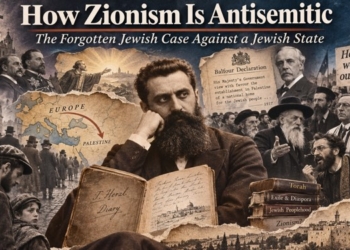
From there, Maté traces the history. He describes early Zionist idealism that still left Palestinians out of its vision, and Jewish thinkers like Ahad Ha’am and Yeshayahu Leibowitz who warned where that path would lead. He also points to research on the trauma carried by Palestinian children, and to the British and American empires that he says have made Israel’s actions possible. He also mourns what he sees as a spiritual loss: in many synagogues, he says, devotion to the state has replaced Jewish spirituality itself.
These are strong claims, and many viewers will strongly disagree. Whatever your view, Maté gives you a framework worth wrestling with, one that connects personal healing, collective trauma, and the moral cost of power used without limits.
Key Takeaways
- Maté describes a “culture of entitled victimhood.” He argues that when a people sees itself as the eternal victim, it feels free to do anything, and morality stops mattering.
- Victimhood is comfortable because it removes responsibility. Using his own marriage as an example, Maté explains that playing the victim lets us avoid looking at our own actions, and he says nations do the same thing on a larger scale.
- His family history gives him no authority, but it breaks a myth. Maté’s grandparents died at Auschwitz. He says this shows that Jewish suffering does not justify harm to Palestinians, and that Jews do not all think alike.
- Visiting Auschwitz confirmed his concern. Standing where his grandparents arrived by train, his first thought was that Jews who see Auschwitz as the essence of Jewish identity will never understand Palestinians.
- He sees the Holocaust as unique in method but not in its lessons. Maté calls its industrialized mass murder unparalleled, but says its broader lessons about brutality and contempt for human life apply today. He also argues that Holocaust remembrance has been used to justify Israeli policy.
- Hardening the heart is the price of domination. Once you decide others have fewer rights, Maté says, you must keep growing more brutal to suppress their resistance, which he calls the “predicted brutalization” of Israeli society.
- Jewish thinkers warned about this long ago. He cites Ahad Ha’am in the 1890s and Israeli scholar Yeshayahu Leibowitz, who both warned about what the treatment of Arabs would do to Jewish society.
- Israel has replaced spirituality for many Jews. Maté questions why synagogues pray for a political state and display its flags, calling the mixing of national loyalty with religion a spiritual disaster.
- Palestinian trauma runs deep and long predates October 7. He cites a 2004 study, conducted before Hamas took power in Gaza, that found traumatic symptoms in over 90% of Palestinian children, and research suggesting war trauma can change how genes function.
- Denying trauma makes it worse. Maté notes that Jewish trauma is widely recognized while Palestinian trauma, and even Palestinian existence, is often denied, which he says compounds the harm.
- Palestinians show remarkable resilience. Drawing on his own work with Palestinians, he praises their strength while warning that even great resilience can be overwhelmed.
- Israel depends on a “big daddy.” Maté argues that Zionism succeeded first with the British Empire’s backing and now with America’s, and that it couldn’t survive without that support.
- Empires don’t last forever. He believes American power is declining and warns that Israel’s position could collapse if that support fades, bringing back the anger its actions have created.
- Public opinion and official policy have split apart. Maté says millions of ordinary people feel grief and shock, while Western governments have responded with complicity and denial.