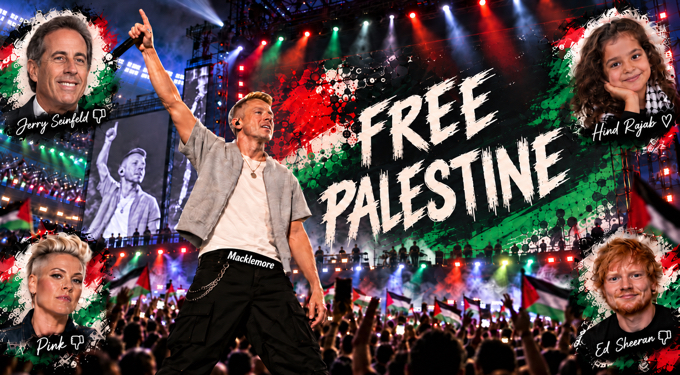

#FreePalestine #Macklemore #Palestine #Gaza #ArtistsForPalestine
Something significant is shifting in the cultural battle over Israel and Palestine. Macklemore declared “Free Palestine” before a packed American stadium and was subsequently banned from performing, while controversies involving Ed Sheeran, Pink, Mark Ruffalo, Jerry Seinfeld, and other major cultural figures are pushing the debate over Israel and Palestine deeper into mainstream culture. Gia Prism sees this as part of a much larger cultural and spiritual “karmic reckoning,” a moment when artists can break through barriers that politicians and activists often cannot, forcing buried history, propaganda, trauma, and deeply ingrained assumptions into public view. The bigger story is not simply who is speaking out, but whether this widening cultural confrontation is weakening long-standing efforts to marginalize criticism of Israel while opening the door to deeper reflection, healing, and collective transformation.
This article unfolds in five parts:
1. Macklemore Says “Free Palestine”—and Pays the Price
Watch the speech that preceded Macklemore’s removal from Ed Sheeran’s Loop Tour. New England Patriots owner Robert Kraft objected to his pro-Palestinian statements, and barred Macklemore from performing at Gillette Stadium, saying the venue would not provide a platform for what he characterized as “hate speech.”
The controversy has an important backdrop: in 2019, Benjamin Netanyahu presented Kraft with the $1 million Genesis Prize in Jerusalem for his philanthropy, commitment to Jewish causes, and support for Israel. The Genesis Prize is Israel's equivalent to the Nobel Prize. Netanyahu declared at the ceremony that “Israel does not have a more loyal friend than Robert Kraft.”
2. A Cultural Reckoning Breaks Into the Mainstream
Gia Prism views the controversy surrounding Macklemore, Ed Sheeran, Pink, and Palestine as part of a much larger cultural and spiritual “karmic reckoning.” Her argument is that artists can break through political barriers that activists and commentators often cannot, forcing buried histories, propaganda, trauma, and deeply ingrained assumptions into the public conversation—and potentially opening the door to reflection, healing, and collective transformation.
EDITOR NOTE: This is a brilliant podcast. It inspired me to write this article. Be sure to watch until the end.
3. Is the Backlash Losing Its Power?
Due Dissidence hosts Keaton Weiss and Russell Dobular connect controversies involving Mark Ruffalo, Adidas, Ralph Lauren, Jerry Seinfeld, Javier Bardem, Hayley Williams, Macklemore, Ed Sheeran, and Pink to what they see as a major cultural shift surrounding Israel and Zionism. Their argument is provocative but clear: criticism of Israel is becoming increasingly mainstream, while efforts to shame, silence, boycott, or professionally punish prominent pro-Palestinian voices appear to be losing some of their cultural force. In their view, the old playbook is beginning to break down.
4. From NAZA to Ed Sheeran: Israel Is Losing the World | Soumaya Ghannoushi | MEE Opinion
Soumaya Ghannoushi argues that recent controversies involving Macklemore, Ed Sheeran’s tour, and the Israeli documentary NAZA illustrate a broader erosion of Israel’s ability to shape international cultural discussion about Palestine. Ghannoushi interprets these episodes as evidence that attempts to suppress pro-Palestinian speech can now generate greater attention rather than silence it: removing an artist makes audiences ask what the artist said, while attacking a documentary can increase interest in seeing it. Her central argument is that although Israel and its supporters may still exert pressure on individual artists, students, filmmakers, institutions, and platforms, they are increasingly unable to control the larger global conversation about Palestine.
5. What You Should Know and Share about Israel, Palestine, and the United States
Finally, we examine a list of false claims, disputed narratives, human-rights abuses, and atrocities attributed to Israel, along with the political, military, and financial support provided by the United States. Together, they help explain why growing numbers of people around the world are questioning narratives about Israel and Palestine that they once accepted without challenge.
PART 1: Watch Macklemore's ‘Free Palestine' speech
Transcript
“I've been trying to figure out a way to say this all day. One of the reasons why I wanted to come on this tour was because I wanted to stand up here on stages and stadiums across America and say two words that are very near and dear to my heart: Free Palestine.
“I said, free Palestine. I want those words to be loud and clear so the people from Gaza all the way to the occupied West Bank know that we have not forgotten them.
“And this next song was inspired by the bravery of Columbia University students who led an encampment movement that mobilized the entire world, open up hearts, myself included. So, thank you to those students that risked their diplomas, that risked their tuition, that risked their scholarships, that stood up and said no. CUAD students, Students for Justice and Palestine, and Jewish Voices for Peace: thank you guys.
“To all of my Jewish brothers and sisters, criticism of Israel, criticism of apartheid, being against genocide, in no way is a criticism of you.
“My message is for peace, love, for all human beings to be treated with dignity, respect, and equality. So I say, free Palestine. I say, free Lebanon. I say, free Cuba. I say, free Congo. Free Sudan. Free all people in America living in fear over this terrorist organization, ICE. [cheering]
“None of us will be free until we are all free. This song is called Hind’s Hall” [watch it HERE – it’s powerful!]
EDITOR NOTE: A primary tactic used to silence debate over Palestinian rights is branding support for Palestinian freedom as antisemitic. Watch THIS video from 2002 with Amy Goodman of Democracy Now and former Israeli cabinet member, Shulamit Aloni, in which Aloni explains that antisemitism allegations are used as a TRICK to silence critics of Israel. (This video used to be on YouTube, but YouTube deleted it.)
Benjamin Netanyahu went even further, declaring that the phrase “Free Palestine” is today’s version of “Heil Hitler.”
PART 2: Macklemore, Ed Sheeran, and Palestine: The Cultural Revolution Just Got Loud
By Gia Prism
OVERVIEW
Gia Prism presents the public controversy involving Macklemore, Ed Sheeran, Pink, and discussion of Palestine as evidence of a larger cultural reckoning moving from activist and political circles into mainstream public discourse. She argues that artists play a uniquely powerful role in this process because their visibility, emotional sensitivity, and cultural influence can bring difficult subjects before audiences that conventional political debate may not reach. Prism situates the Palestine discussion within a broader spiritual and psychological framework of “karmic reckoning,” contending that nations and individuals must confront unresolved histories, inherited assumptions, propaganda, trauma, and patterns of division before genuine unity becomes possible.
She describes the United States as undergoing a “dark night of the soul” in which foundational contradictions involving genocide, slavery, racism, and bigotry are resurfacing for examination, while arguing that similar processes must occur in countries around the world. In discussing Pink’s response to the controversy, Prism emphasizes the psychological effects of personal and collective trauma, suggesting that people interpret political events through the lens of their own wounds and therefore may have different capacities to absorb information that challenges deeply held beliefs.
Her larger message is that cultural confrontation does not have to end in polarization: if individuals undertake personal healing and “shadow work,” public disagreements can become opportunities for greater understanding, integration, and ultimately collective healing.
PART 3: ZIONISM IN RETREAT: Comics BOYCOTT Seinfeld, Pink FAILS To Cancel Macklemore
By: Due Dissidence (Keaton Weiss and Russell Dobular)
OVERVIEW
In this episode, Due Dissidence hosts Keaton Weiss and Russell Dobular argue that several recent controversies involving Mark Ruffalo, Adidas, Ralph Lauren, Jerry Seinfeld, Javier Bardem, Hayley Williams, Macklemore, Ed Sheeran, and Pink collectively signal a major change in the cultural influence surrounding Israel and Zionism. Their central thesis is that public criticism of Israel—particularly over the Gaza genocide is becoming increasingly common in entertainment and popular culture, while efforts to stigmatize, pressure, or professionally punish prominent critics are becoming less effective.
They cite the rapid defense of Ruffalo by Jewish artists after accusations of antisemitism, Adidas reportedly retreating from a controversial campaign, boycott calls involving Ralph Lauren and Gal Gadot, performers withdrawing from a Portuguese comedy festival headlined by Seinfeld, Bardem openly advocating a boycott, Williams declaring support for Palestine at a concert, and Macklemore saying “Free Palestine” twice while opening for Ed Sheeran.
The hosts devote particular attention to Pink’s sharing of a StopAntisemitism post criticizing Macklemore and Sheeran, interpreting the backlash against Pink as evidence that the cultural balance has shifted. They also discuss reported Israeli emigration figures and declining return migration, connecting these trends to their broader argument that Israel may face increasing cultural isolation, economic pressure, and demographic strain.
Throughout, the underlying argument remains consistent: the hosts believe criticism of Israel has moved from a professionally risky position toward an increasingly mainstream cultural stance, and they interpret the ability of artists to criticize Israel without major career repercussions as evidence of an important political and cultural tipping point. Israel’s propaganda playbook is finally falling apart.
PART 4. From NAZA to Ed Sheeran: Israel Is Losing the World
By Soumaya Ghannoushi | Middle East Eye
OVERVIEW
In this Middle East Eye opinion commentary, Soumaya Ghannoushi argues that controversies involving Macklemore, Ed Sheeran’s tour, and the Israeli documentary NAZA reflect Israel’s declining ability to control the cultural conversation about Palestine. She focuses especially on the role of artists, beginning with Macklemore’s “Free Palestine” declaration and performance of “Hind’s Hall,” followed by his removal from the tour and the withdrawal of several other performers in solidarity. Ghannoushi places these artists in a longer tradition of musicians who challenged the Vietnam War and apartheid South Africa, arguing that art gives names and faces to suffering that politics often reduces to statistics. She then turns to NAZA, based on testimony from 24 Israeli military and intelligence insiders about Gaza targeting practices, which received a lengthy standing ovation in Venice while provoking fierce condemnation in Israel. Ghannoushi’s central argument is that efforts to silence artists and filmmakers are increasingly backfiring: suppressing a performance or attacking a film often draws greater attention to the very message being targeted, making the broader global conversation about Palestine harder to control.
PART 5: What You Should Know and Share about Israel, Palestine, and the United States
- Israel is a ‘nation of child killers'. Middle East scholar Norman Finkelstein said that during his recent interview with Tucker Carlson. Finkelstein also called Benjamin Netanyahu the “perfect reflection” of Israeli society. Finkelstein, whose parents were Jewish survivors of Nazi concentration camps, has repeatedly accused Israel of deliberately targeting Palestinian children during its assault on Gaza. “Israel has become a nation of child killers. They kill children for play. There is ample documentation of snipers killing children, drones killing children.” UNICEF and MoH-derived figures put at least 21,700 children killed in Gaza as of June 30, 2026, with hundreds more since. NOTE: Finkelstein has focused on the Israeli-Palestinian conflict and Middle Eastern studies for over 43 years, beginning with his involvement and research in 1982 following the Israeli invasion of Lebanon. He has written numerous books on the topic including Gaza's Gravediggers: An Inquiry into Corruption in High Places. Bottom line: Finkelstein is one of the world's foremost experts on this topic.
- The United States is “COMPLETELY COMPLICIT” in the MURDER of Palestinians and the ANNIHILATION of Gaza. The U.S. government not only bankrolls the bombs, it also shields Israel from accountability on the world stage: “America is the guarantor of Israeli impunity. We could not be where we are today if America had not gotten us to a place where there are no costs and consequences internationally, legally, in terms of sanctions… for the way Israel has treated Palestinians for generations.” (There's much more. Do watch this.) P.S. Does anybody truly believe the idiotic notion that we support Israel because the Bible says we will be blessed if we bless Israel? If so, WATCH THIS!
- Israelis BELIEVE they are the CHOSEN PEOPLE and therefore have the right to do whatever they want – including the systematic dehumanization and murder of Palestinians. ~ Gideon Levy, award-winning Israeli journalist (watch him say this and more HERE)
- Israel Knew Hamas' Oct 7 Attack Plan and ALLOWED It To Happen. There is ZERO doubt that Israel not only allowed it to happen (IDF soldiers were ordered to stand down), but many of the Israelis who died on October 7 were killed by the IDF (allegedly to prevent them from being captured as hostages).
- It was NEVER about Hamas. It was ALWAYS about BOMBING EVERYTHING AND EVERYONE IN GAZA. In the first 48 hours after the October 7, 2023 attack, after then–IDF Chief of Staff Herzi Halevi reported that the IDF had attacked 1,500 targets in Gaza, Netanyahu angrily replied: “I’m not interested in targets. Take down houses; bomb with everything you have.” To view the source article, Google: “The Wars of Herzi Halevi”
- Netanyahu refused an “all for all” hostage exchange (Hamas's original demand) shortly after October 7 (and many times after that) – so that Israel could continue their bombing campaign.
- The Untold History of Palestine and Israel. Abby Martin presents a sweeping history of Palestine and Israel, portraying Zionism, the Nakba, military occupation, and settlement expansion as interconnected stages in the dispossession of Palestinians.
- Israel planned to colonize Palestine long before 1948, which was when the UN Partition Plan allocated about 55% of historic Palestine to a Jewish state. This video has 3 parts that show Israel intended to colonize Palestine under its Greater Israel plan: (1) Jewish journalist Katie Halper: “Everything that Israel tells you about its founding, about its history, and about its role today is a lie. Some people think, ‘oh, Israel was founded for Holocaust Survivors and then it got greedy and took over too much land and and ruined its founding mission, which was to be a safe haven for Jews… The truth is: Israel was founded on ethnic cleansing. I think it's really eye opening to look at the actual language of early Zionists because they were calling their Banks colonial trusts. They were talking about how natives always resist colonists. In other words, it's not just critics of Zionism who describe Zionism as colonial. It was Zionists themselves.” (2) On Sept 22, 2023 (15 days BEFORE the October 7 attack), Netanyahu presented a map to the United Nations General Assembly in which Palestine was erased – with both the West Bank and Gaza folded into Israel. (3) Netanyahu said he is on a “historic and spiritual mission” and declared himself “very” attached to the vision of a “Greater Israel.”
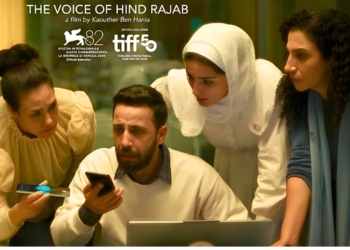
- The Biggest Lie We've Been Sold: Israelis Good, Palestinians Bad. This documentary-style video by Ross Pittman dismantles one of the most deeply ingrained narratives Americans have been taught about Israel and Palestine: that Israelis are the victims and Palestinians the villains. Drawing on speeches, firsthand testimony, historical context, and deeply human stories (including The Voice of Hind Rajab), it examines how that narrative was built, how propaganda sustains it, and the devastating human consequences of accepting it without question.