
#PersonalGrowth #SelfAwareness #PeoplePleaser #Boundaries #BreakThePattern
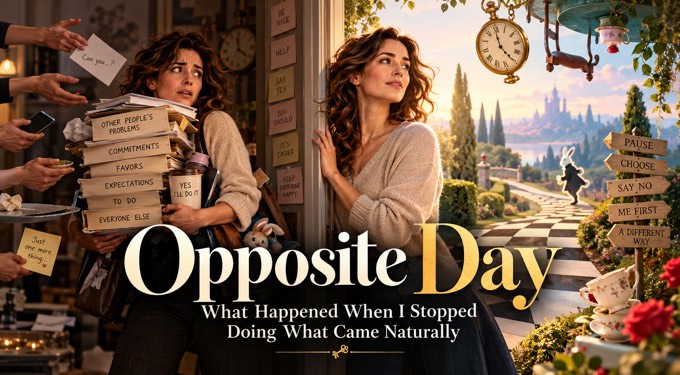
It started with an idea from Alice in Wonderland.
What if I stepped into my own version of Wonderland and deliberately turned some of my usual rules upside down?
Not forever. Not because there was anything fundamentally wrong with me. Just as an experiment.
I wanted to see what would happen if, for a while, I stopped automatically doing what came naturally and tried the opposite instead.
I called it Opposite Day.
It was meant to last one day. Then one day became a week. The week became a month. And the month became something I hadn’t expected.
When I changed some of my habitual responses, I began to experience myself differently. That’s when the experiment became interesting.
Breaking My Own Rules
I had spent much of my life being what I would jokingly call a “good girl”.
I was a people pleaser and a rescuer. I was quick to help, quick to say yes and often quick to take responsibility for things that weren’t mine to carry.
None of it was particularly conscious. That was the point.
I wasn’t waking up each morning thinking: Today I shall please everyone. It was simply how I operated.
So, I decided to play with that.
If my automatic response was yes, I paused.
If I felt compelled to fix something for someone else, I stopped and asked whether it was really mine to fix.
If I caught myself slipping into an old response just because it was familiar, I tried something different.
I wasn’t trying to become uncaring or difficult. I wanted to find out what existed on the other side of my usual response.
What would happen if I didn’t do what I normally did?
A Small Experiment Becomes Something Else
At first, it felt strange.
There is a certain comfort in familiarity, even when that familiarity isn’t serving us well.
When you’ve responded to life the same way for years, the response starts to feel like you.
That’s just how I am.
I’m the one who helps.
I’m the one who says yes.
I’m the one who sorts things out.
I’m the one who keeps things moving.
But what happens when you interrupt that?
I discovered there was a space between the impulse and the response. And in that space, there was choice.
I could pause. I could think. I could ask myself what I actually wanted.
That sounds simple. It wasn’t always easy. But it was surprisingly powerful.
The World Didn’t Fall Apart
One of the most interesting things about experimenting with our own behaviour is discovering what happens when we stop assuming we already know the outcome.
I had my expectations about what might happen if I stopped automatically saying yes or stepping in to help. Would people be upset? Would they think I had changed? Would I feel guilty? Would I regret it?
Sometimes the answer was yes. Some people did respond differently. And sometimes I felt uncomfortable.
But something else happened too.
The world didn’t fall apart.
People managed. Situations carried on. And I began to realise that some of what I had been doing automatically wasn’t as essential as I had imagined.
That was a useful discovery. Not because I decided never to help anyone again. Quite the opposite. I still wanted to help.
The difference was that I was beginning to choose when I helped, rather than assuming I should.
Who Said It Had to Be This Way?
This became the question underneath the whole experiment.
Who said I had to respond this way?
Who said I had to say yes?
Who said I had to fix it?
Who said I had to keep doing something just because I always had?
And perhaps the bigger question:
Who would I be if I gave myself permission to choose differently?
There was something liberating about treating my behaviour as an experiment rather than a personality test.
I didn’t have to decide the old me was wrong. I didn’t have to build a completely new version of myself. I could simply try something else and see what happened.
Some experiments worked. Some didn’t. Some felt natural surprisingly quickly. Others felt incredibly awkward.
All of them taught me something.
From Reaction to Choice
Over time, I noticed that the biggest shift wasn’t in what I was doing. It was in the pause before I did it.
That tiny moment became important. Instead of reacting automatically, I could stop and ask myself:
Is this what I really want?
Is this mine to do?
Am I choosing this, or am I repeating something familiar?
Those questions gave me room to choose, to change my mind and to discover that I could behave differently without losing myself.
And perhaps that is the strangest thing about the experiment. I had set out to become my opposite. Instead, I became more aware of who I actually was.
A Different Kind of Freedom
Eventually, I shared the experiment with people around me.
What surprised me was how many of them wanted to try their own version. Not because they wanted to become someone else, but because they recognised the feeling of being caught in something automatic.
One person always says yes. Another always stays quiet. Someone else always takes control. Still another keeps waiting for the “right” moment.
We all have ways of moving through the world that become so familiar we stop noticing them.
Perhaps we don’t always need to break those patterns completely. Sometimes we just need to question them.
What if there is another option?
What if I tried it once?
What might I learn?
Try Your Own Opposite Day
I’m not suggesting we all start behaving completely out of character. That could get chaotic rather quickly.
But there may be real value in choosing one small thing and experimenting with it.
If you always say yes, pause before answering.
If you always wait for certainty, take one small step without it.
If you always need to be in control, let something unfold without managing it.
If you always follow the same routine, change one small part of it.
If you always see a situation from one perspective, deliberately look at it from another.
Not because the opposite is necessarily better. Simply because another possibility exists.
My experiment began with a simple question:
What would happen if I did the opposite?
I thought I was experimenting with my behaviour. What I discovered was that I was really experimenting with possibility.
Perhaps that’s what happens when we give ourselves permission to step outside the familiar script.
We don’t become someone else.
Sometimes, we simply discover more of ourselves.