

#TattooHealth #ImmuneSystem #TattooSafety #HolisticHealth #ConsciousLiving
I’ve always thought of a tattoo as a skin-deep decision. You choose the design, you sit through the needle, and the ink stays where the artist put it. It turns out that picture is incomplete, and the real story should give anyone with a tattoo, or thinking about getting one, reason to pause.
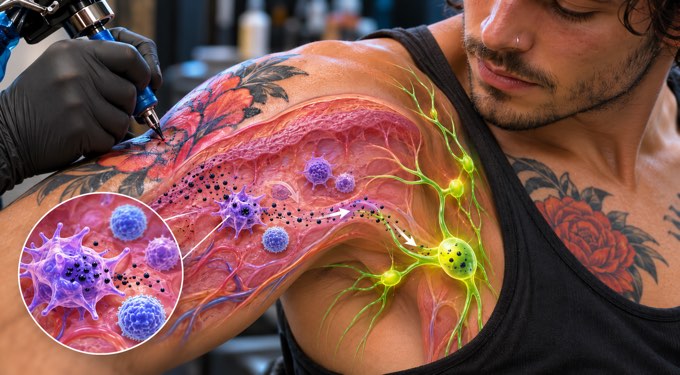
New reporting from ScienceAlert pulls together a growing body of research showing that tattoo ink doesn’t just sit quietly under the surface. Ink particles can travel through the lymphatic system and build up in lymph nodes, the body’s filters for debris, abnormal cells, and foreign substances. Meanwhile, the ink that stays in the skin keeps your immune system working for years. Immune cells recognize the pigment as foreign and try to remove it, but the particles are too large, so the response never fully ends. That ongoing standoff is the very reason tattoos are permanent.
None of this means tattoos are dangerous. Medical microbiologist Manal Mohammed, the article’s main expert, puts it plainly: “Tattoos remain a powerful form of self-expression, but they also represent lifelong chemical exposure.” For anyone who sees the body as something to honor and care for, that’s worth knowing before you book your next session.
Key Takeaways
- Your body never stops reacting to a tattoo. Pigment in the dermis is treated as a foreign invader, and because immune cells can’t clear particles that large, the response continues long-term.
- Ink travels beyond the skin. Particles can move through the lymphatic system and collect in lymph nodes. In some reported cases, ink buildup has even mimicked the appearance of lymph node cancer on scans.
- Many tattoo pigments weren’t made for skin. Modern inks contain pigments, carriers, preservatives, and trace impurities, and many pigments were originally developed for car paint, plastics, and printer toner.
- Trace heavy metals show up in some inks. Nickel, cobalt, chromium, and occasionally lead have been found, and at high levels these metals are linked to organ damage, neurotoxicity, and higher cancer risk. The amounts in ink are small, but exposure lasts a lifetime.
- Red, yellow, and orange inks cause the most trouble. These colors are more often tied to allergic reactions and chronic inflammation, and red ink in particular is associated with persistent itching, swelling, and granulomas.
- Sunlight and laser removal can change ink chemistry. Azo pigments can break down into aromatic amines under certain radiation, and lab studies have linked those compounds to cancer and genetic damage.
- Black ink has its own concerns. Black pigments may contain polycyclic aromatic hydrocarbons, the same compounds found in soot and exhaust, many of which are classed as carcinogenic.
- The cancer question is still unsettled. One observational study from late 2025 found a 29% higher melanoma risk among tattooed people, while another study found no link at all. There is no strong human evidence that tattoos cause cancer.
- Infection is the most immediate risk. Breaking the skin barrier opens the door to infections such as Staphylococcus aureus, hepatitis B and C, and atypical mycobacteria.
- Some people should be extra careful. Mohammed notes that chronic inflammation is linked to tissue damage, and that people with autoimmune conditions or weakened immune systems may face added concerns.
- Ask questions before you get inked. The article recommends asking your artist about their inks and hygiene, and talking to a doctor first if you have a history of immune problems.
- Regulation hasn’t caught up. The tattoo industry remains largely unregulated in many countries, which is why researchers are calling for clearer ink labeling and more long-term study.
So far, there’s no strong evidence linking tattoos to cancer in humans, although lab and animal studies suggest the risk may be real.