
RobertGreene #TheLawOfTheSublime #Awe #Consciousness #PersonalGrowth
Have you ever looked up at the night sky and felt, just for a second, how small and strange it is to be alive on a spinning rock in all that darkness? I have. And I’ve always wondered why the feeling fades so fast. A minute later I’m thinking about emails, or what’s for dinner, and the world goes back to being ordinary.
Robert Greene has spent the last seven years trying to answer that question. He’s best known for The 48 Laws of Power, Mastery, and The Laws of Human Nature. His new book, The Law of the Sublime, is a different kind of book. It isn’t about power or about dealing with other people. It’s about how you experience being alive.
What makes it so moving is how it came about. Greene’s first plan was to go after big adventures. He’d travel down the Amazon, find chimpanzees in the wild, and cross the Gobi Desert, then write about what he felt. In August 2018, though, he was driving in Los Angeles when his girlfriend saw that his speech was slurred and one side of his face was drooping. She screamed at him to pull over and called 911. A blood clot in his neck was cutting off oxygen to his brain. Within seconds he was unconscious.
In that darkness he had strange sensations. He felt his bones dissolving and saw images of his own funeral. When he woke up in the hospital, the left side of his body barely worked, and yet he felt oddly elated. On the ambulance ride home he watched people walking past his window and had the sense that he could get inside their bodies and hear their thoughts. He told himself, “This is the sublime.”
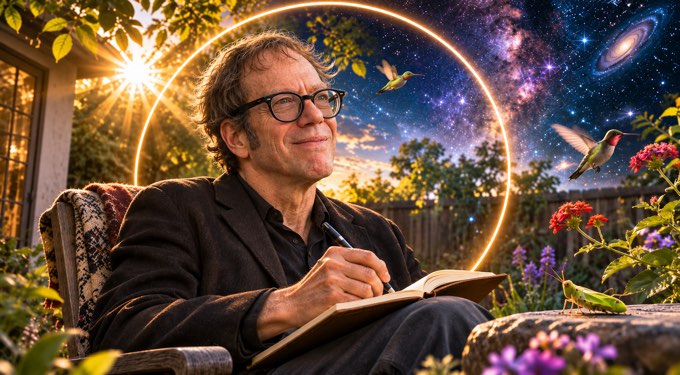
The stroke ended the adventure plan, so Greene had to find the sublime where he was. One afternoon he woke from a nap in his backyard to find a grasshopper a few inches from his face, and he saw that his small backyard would have to be his Amazon jungle. Lizards, squirrels, hummingbirds, and insects all started to look like the wondrous, weird creations of evolution they really are.
He couldn’t type, so he wrote the whole book by hand and filled more than a hundred notebooks. He drafted each passage, recopied it, edited it, dictated it into a computer, printed it out, and edited it again with one hand. He calls the process incredibly laborious. He also calls it a blessing, because it forced him to find wonder in the simplest things. That’s exactly what he wants readers to learn.
His central image is a circle. Inside it is everyday consciousness, shaped by the habits, rules, and conventions of our culture. Greene thinks technology is making that circle smaller. Just outside it is the sublime, a place that is frightening and exciting at once. The book maps out 12 doorways that lead outside the circle, and each chapter ends with exercises to help you bring that experience into daily life.
Two Stories That Will Change How You See Reality
In this short clip with Chris Williamson, Greene tells two stories from the book. The first is about Vladimir Arsenyev, a Russian explorer sent to map uncharted parts of the Siberian taiga in the early 1900s. He takes on a guide named Dersu Uzala, an Indigenous hunter in his fifties or sixties who can read the forest the way we read a book. Dersu can tell from a set of tracks which animal passed and what mood it was in. He can smell a storm two days before it arrives. When a Siberian tiger appears, Arsenyev reaches for his rifle. Dersu tells him to put it away, walks toward the tiger, and talks to it calmly until it leaves.
The second story is about a mountain climber who falls 30 feet in a storm, cracks his knee open, and lands on a ledge barely a foot wide. He’s sure he’s going to die. Then a voice inside him tells him to get to his feet, and a rush of energy carries him down the mountain “like a mountain goat.” He spends the next 20 years trying to feel that again.
Greene’s point is that we hold powers we’ve lost touch with, because most of us are disconnected from our senses, our bodies, and our own mortality.
The Deep Dive: Robert Greene and Andrew Huberman
If you have a couple of hours, this conversation with neuroscientist Andrew Huberman is a gift. Huberman calls Greene’s Mastery one of his all-time favorite books, and he says the topics in this conversation may be the most important Greene has ever covered.
They talk about how the brain builds what we call reality, why childhood felt so vivid, how time can stretch and bend, why handwriting changes the way we think, and how love, music, science, and even a fish tank can become doorways to the sublime. Greene also gets candid about how the stroke made him more emotional and more empathetic. He says it moved the sublime out of his head and into his body.
Key Takeaways
- The sublime is all around you, not somewhere far away. It’s the moment when something familiar suddenly looks strange and wondrous: sunlight on a building, an abandoned parking lot with weeds coming up through the asphalt, or the true scale of the night sky. Greene says you don’t need travel or exotic adventures to find it, only “a new pair of eyes.”
- A near-death experience changed Greene’s whole approach. His 2018 stroke brought him close to death, and afterward ordinary life looked “weird and marvelous.” That shift is what convinced him it was time to write the book.
- Everyday consciousness is a circle, and it’s getting smaller. The circle is made of the rules, codes, and conventions that tell us how to think and feel. Greene believes technology is narrowing it further, leaving many of us bored and restless.
- The word “sublime” means “up to the threshold.” Greene describes 12 doorways out of the circle, one per chapter. Stepping through them mixes pain and pleasure: it’s uncomfortable because it’s unfamiliar, and exciting for the same reason.
- Limitations can become a gift. With a frozen left hand and limited mobility, Greene compared himself to a bird in a cage that had to learn to sing inside it. His small backyard became his jungle. If a stroke survivor can find the sublime, he says, anyone can.
- Slowness changes the way you think. Writing by hand forced Greene to slow down and focus more deeply. He points out how closely the hand and the brain are linked, and how dictation, though easier, felt like it lost something essential.
- Your senses are far more capable than you realize. Dersu Uzala could read animal tracks, broken branches, and the weather with uncanny precision. Greene sees him as proof of an intelligence humans once had and have largely lost.
- Danger can wake up dormant powers. The fallen climber’s sudden strength came from his body’s own chemistry. Greene argues that even the most rigid office worker, dropped alone on an island, would start discovering “quote unquote supernatural powers.”
- Attention is the doorway. Greene describes the mystic G.I. Gurdjieff’s practice of “self-remembering,” which means focusing deeply on a moment and telling yourself you’ll remember it. After months of practice, Gurdjieff’s student P.D. Ouspensky found that houses and flowers began to look almost alive. The practice also made him see how asleep we usually are.
- Try to see things as they are, not as what they’re for. A cup is normally just something to drink from. Look at it closely, though, and its shape, color, and material become strange and fascinating. The painter Paul Cézanne stared at a single apricot tree for exactly this reason, so that he saw the tree and not just the word “tree.”
- Time is more flexible than you think. Greene believes childhood felt so rich because there was empty space between our thoughts. Today our attention is broken into countless splinters. Meditation, music, and near-death moments can all slow time down or stretch it.
- Stop reporting your life and start experiencing it. When you’re filming a concert or posting a hike, you’re living the experience from the outside. Huberman and Greene agree that something important is lost when you experience life at the speed you plan to share it.
- Your childhood holds clues to your life’s task. For people who don’t know what they’re meant to do, Greene suggests a kind of archaeology: dig into early memories of real excitement, the ones that had nothing to do with what parents or teachers said. He also suggests paying attention to what frustrates and repels you, because that’s information too.
- Love is one of the most powerful forms of the sublime. Greene calls falling in love a real fall. It means dropping your defenses and becoming vulnerable, which is frightening. In a cynical, self-protective culture, he says, letting yourself fall completely is a form of rebellion.
- The need for transcendence is as basic as the need for shelter. Greene believes that losing a sense of something larger than ourselves is part of why the world feels so unmoored. He doesn’t call for a return to organized religion. He suggests that the discoveries of science, from the human brain to the cosmos, can bring back that sense of awe.
- The sublime belongs to everyone. It isn’t reserved for the wealthy or the adventurous. You can find it in a small apartment, a backyard, a piece of music, or the face of someone you love.