

#SpaceExploration #Robotics #Caltech #DARPA #FutureTech
I spent more than 30 years in aerospace, and one problem never went away: everything we sent into space had to fit inside a rocket. Every antenna, every solar panel, every structure was squeezed, folded, or broken into pieces that humans then had to put together. So when I read that a robot had built something in orbit on its own, with no astronaut lending a hand, I sat up a little straighter.
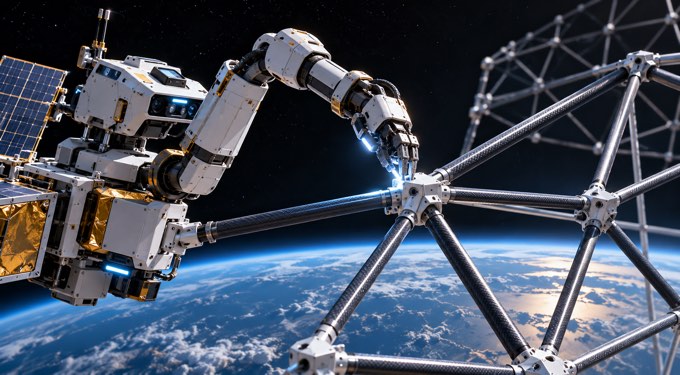
The robot is called ASTRA, short for Autonomous In-Space Tensioned Reflector Assembly. It was developed by researchers at Caltech and funded by the US Defense Advanced Research Projects Agency (DARPA). Working step by step, ASTRA assembled composite fiber tubes and aluminum joints to build one bay of a planned reflector antenna about 1.4 meters (4.6 feet) across. That’s a small start. Still, it shows the idea works.
The process itself is elegantly simple. The core materials and building blocks are packed together for the trip into space, and once there, the robot takes over the job of piecing them together. When one section is finished, it gets connected to the existing structure, and work on the next section begins. Piece by piece, the structure grows.
Why does this matter? Until now, space structures were either assembled by hand or folded for launch and unfurled in orbit. Robotic assembly offers a third path, and it doesn’t have the size limits of the other two. The long-term goal is structures spanning hundreds of meters or even kilometers, built in space from parts that pack neatly into a rocket.
There’s something quietly profound in that. We’re learning to build where we want to be instead of only where we happen to be.
Key Takeaways
- A robot built a structure in space without any human help. The article calls this a first for space construction, marking a shift from astronaut-assisted assembly to fully autonomous building.
- ASTRA was designed at Caltech with DARPA funding. It was part of DARPA’s NOM4D (Novel Orbital and Moon Manufacturing, Materials and Mass-efficient Design) program, launched in 2022.
- The finished piece is small but significant. The robot completed one bay of a reflector antenna roughly 1.4 meters wide. Only this first part is done, but the developers say it proves the technology is feasible.
- The approach is built to scale. Because the robot adds one completed section at a time, the same method can keep going far beyond a single antenna bay. The Caltech team says these techniques can be applied to much larger projects.
- Some structures are simply too big to build on the ground. Team lead Sergio Pellegrino, an aerospace engineer at Caltech, explained that once structures grow too large to prebuild and unfold, they have to be built in space.
- The potential uses are enormous. Possible applications include astronomy, astrophysics, communications, and very large solar arrays for space-based solar power.
- A space economy will need big infrastructure. DARPA’s NOM4D program manager Andrew Detor said a future space economy will require large structures such as depots, habitats, solar arrays, and radio antennas.
- More in-space manufacturing is on the way. Another NOM4D project from the University of Illinois Urbana-Champaign is scheduled to launch to the International Space Station before the end of 2026, where it will test turning liquid materials into solid ones to shrink launch payloads. NASA also runs its own in-space servicing, assembly, and manufacturing mission.