
#ArtificialIntelligence #FederalReserve #Inflation #FutureOfWork #KevinWarsh
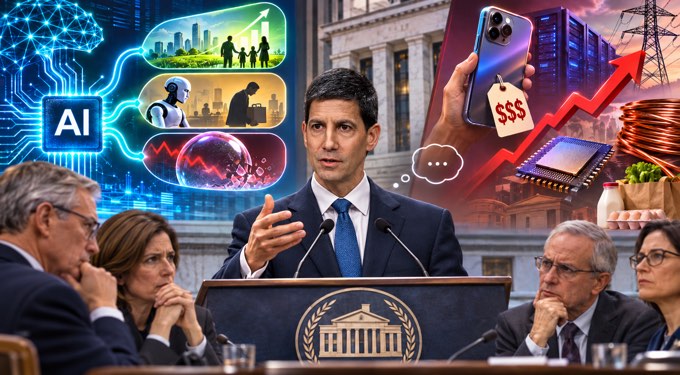
Last month I bought a new phone and winced at the price. It turns out I wasn’t imagining it. According to the government, smartphone prices rose last month at the fastest pace on record, and a lot of economists point to one cause: the race to build AI.
That made Monday’s speech by Federal Reserve Chairman Kevin Warsh more interesting than usual. He kicked off a one-day conference on AI and productivity at the San Francisco Fed, the first hearing of a task force he created to study how AI will affect jobs and growth. His message was mostly upbeat. Warsh believes AI could speed up innovation and bring in an era of faster economic growth, a view that puts him at odds with many of his colleagues.
He was also candid about the dangers. He described three possible futures: one where everyone benefits, one where the economy grows while jobs disappear, and one where the AI investment boom goes bust and drags down the stock market.
What he didn’t mention was inflation. Many Fed officials now blame the buildout of data centers for pushing prices up, because it’s driving demand for chips, electronic components, electricity, and copper. Inflation picked up last month, and several members of the Fed’s rate-setting committee have signaled support for more rate hikes, possibly as soon as December. Warsh didn’t say a word about rates or the latest inflation numbers. In an economy where AI may be both the cure and the cause, his silence on prices was hard to miss.
Key Takeaways
- Warsh sees AI as a growth engine unlike anything before it. He argued that electricity and the combustion engine sparked decades of innovation but never generated ideas themselves. In his view, AI “could supercharge idea generation,” changing both how innovation happens and how quickly. If that spreads widely, growth could stay well above its long-run average.
- He’s approaching the subject with questions, not answers. Warsh called the hearing a modest effort to figure out what to ask, and he said the Fed is weighing AI’s effects “in a sober and serious way.” The key questions concern the magnitude, scope, and timing of AI’s effects, including whether AI will drive productivity gains, whether it will raise living standards by spreading specialized knowledge, when any AI-driven surge will start and taper, and whether it will arrive sooner in the U.S. or in other countries. finance.yahoo.com
- Scenario one: everyone wins. Productivity gains are shared by workers and investors alike. Inflation-adjusted growth stays above its long-run average, and the U.S. remains near full employment.
- Scenario two: growth with pain. AI replaces jobs instead of supporting them. The economy still grows faster than normal, but widespread automation pushes unemployment higher.
- Scenario three: the bubble bursts. The huge sums poured into AI infrastructure fail to deliver the returns investors expect. Valuations fall, the economy slows, and unemployment rises even more. The economy eventually recovers, but without the productivity boost.
- Inflation was the missing piece. Warsh has long said AI will make the economy efficient enough to grow without worsening inflation. Other Fed officials see the opposite happening right now. The AI buildout has raised the cost of chips, components, electricity, and copper, and those costs are showing up in what we pay for phones, computers, and other electronics.
- A rate hike may be coming, and Warsh isn’t saying. After inflation sped up last month, many of his colleagues signaled support for further rate increases, including at the December meeting. Warsh gave no hint either way. In July he called the internal Fed debate over AI spending “one of the good family fights.”
- Even his vocabulary has a political edge. Warsh refers to AI as “SI,” short for super-intelligence, the term President Trump prefers.
- The task force brings in outside voices. Members include Marc Andreessen, co-founder of Andreessen Horowitz; Asha Sharma, executive vice president and Xbox CEO at Microsoft; and Charles Jones, a Stanford economics professor currently on leave at Anthropic. It’s one of five groups Warsh launched in June, covering communications, balance sheet policy, economic data, productivity and jobs, and inflation frameworks. finance.yahoo.comkeyt