
#Zionism #JewishHistory #AntiZionism #Antisemitism #Palestine
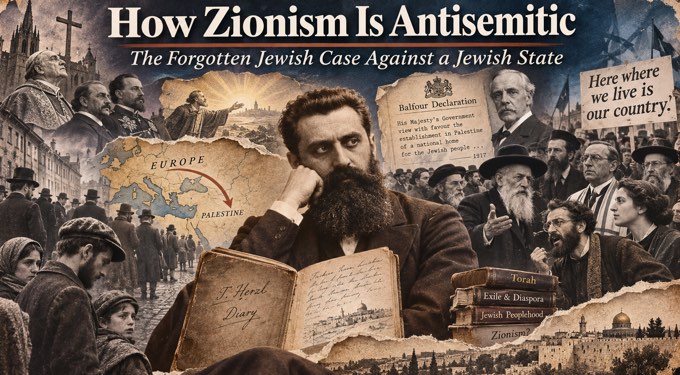
When I first saw the title of this video, I hesitated. Most of us have been taught that Zionism and Judaism go hand-in-hand, and that questioning one means attacking the other. So I watched expecting a rant. What I got was a history lesson I had never heard, built largely from the words of Jewish historians, rabbis, and Theodor Herzl’s own diary.
The documentary, from the independent channel Uncivilized, makes a bold claim: Zionism didn’t begin as a Jewish idea at all. It started in Christian Europe, among Protestants who wanted Jews out of Europe and back in the Holy Land to bring about the Second Coming. Later, European politicians who wanted to be rid of their Jewish populations took the idea up as well. The video’s core point is simple and uncomfortable. If you believe Jews can only be safe in a land of their own, you’ve accepted the antisemite’s premise that Jews don’t belong anywhere else.
From there, the film turns to Herzl, the founder of modern political Zionism. It portrays him as an assimilated, deeply insecure man who absorbed the prejudices of the society around him. Before he settled on a Jewish state, he even toyed with staging a mass conversion of Jews in a cathedral. He imagined his future state as “a portion of a rampart of Europe against Asia, an outpost of civilization as opposed to barbarism,” and he wrote openly in his diary that “the anti-Semites will become our most dependable friends, the anti-Semitic countries our allies.”
The most striking part of the video is how many Jews fought Zionism from the start. Orthodox rabbis rejected it on religious grounds. Reform leaders saw Judaism as a faith, not a nationality. The Jewish Labor Bund, a socialist party founded in Tsarist Russia that later became a major force in Poland, called Zionism the Siamese twin of antisemitism and lived by the motto “Here where we live is our country.” Even Edwin Montagu, the only Jewish member of the British cabinet, warned that the Balfour Declaration was antisemitic in effect.
The film then takes on the Haavara (Transfer) Agreement of 1933. Under that deal, Zionist organizations and Nazi Germany arranged for about 60,000 German Jews and their assets to move to Palestine. The video argues that the price was undermining the worldwide Jewish boycott of Hitler’s Germany. It closes by bringing the story into the present, arguing that Zionism has always needed Jewish fear to survive and that Jews deserve to reclaim the long anti-Zionist chapter of their own history.
Whether you agree with every conclusion or not, this documentary will challenge what you think you know. It’s worth watching with an open mind and a willingness to check the history for yourself.
Key Takeaways
- The video argues that Zionism’s central idea is itself antisemitic. The belief that Jews cannot truly belong anywhere except in a land of their own echoes what Europe’s antisemites had said for centuries.
- The first “Zionists” were Christian, not Jewish. After the Protestant Reformation, some European Christians pushed for a Jewish return to Palestine, partly to get Jews out of Europe and partly to hasten the Second Coming, when Jews would be expected to convert.
- European antisemitism set the stage. Jews in Western Europe were forced to wear identifying badges and hats, and in Eastern Europe most were confined to the impoverished Pale of Settlement and endured repeated pogroms.
- Herzl absorbed the prejudices of his time. Drawing on Herzl’s diaries, the film shows him blaming Jews for causing antisemitism, describing synagogue worshippers in ugly stereotypes, and once considering a mass conversion of Jews to Christianity.
- Herzl’s vision was imperial. He wanted a Jewish state that would serve as “a rampart of Europe against Asia,” and he hoped Jews would give up their living languages, ideally adopting German.
- The film portrays Herzl as driven by personal ambition. It cites his diary fantasies of founding a royal dynasty over the Jewish state, including a plan to give his four-year-old son a ducal title.
- Most Jews originally rejected Zionism. For decades it was one of the most fiercely debated questions in the Jewish world, and many rabbis in Austria, Germany, France, Britain, and the United States opposed it outright.
- Orthodox Judaism forbade a Jewish state before the Messiah. According to the rabbis featured in the film, Jews were to remain in exile until the Messiah arrived, and seizing land by force violated the Torah’s commands against killing and stealing.
- Reform Judaism also said no. Its founders saw Jews as a religious community rather than a separate nation and feared Zionism would undermine Jewish citizenship in their home countries.
- The Jewish Labor Bund championed “hereness.” This proudly Jewish socialist party organized unions, fought pogroms, and became the largest Jewish party in cities like Warsaw and Łódź. It rejected the idea that Jews should leave their homes.
- Jewish opposition forced the first Zionist Congress to relocate. A coalition of Orthodox and Reform rabbis blocked Herzl from holding it in Munich, so it moved to Basel in 1897.
- A Jewish British cabinet member warned against the Balfour Declaration. Edwin Montagu wrote that the policy was “anti-semitic in result” and would become a rallying ground for antisemites worldwide.
- Herzl openly courted antisemites. He wrote that he would seek help from antisemites “as I would from the devil,” and predicted that antisemitic nations would become Zionism’s allies.
- Lord Balfour himself had restricted Jewish immigration. Twelve years before the Balfour Declaration, he had backed Britain’s Aliens Act, which kept out Jews fleeing pogroms in Eastern Europe.
- The Haavara Agreement linked Zionism to Nazi Germany. The 1933 deal moved about 60,000 German Jews and their assets to Palestine. The video argues that it undercut the global Jewish boycott of Hitler’s regime and funded the future Jewish state.
- Many German Jews never wanted to go to Palestine. The film notes that most considered themselves fully German, and that they were not consulted on the arrangement.
- The video claims Zionism has needed Jewish fear from the beginning. It quotes Herzl calling “the misery of the Jews” the movement’s propelling force, and points to the 1950-51 bombings of Jewish sites in Baghdad as an example. (Israel has always denied involvement, and historians still dispute who was responsible.)
- The film calls on Jews to reclaim their anti-Zionist history. Its closing argument is that Zionism is a European political project that has taken over the name and history of a people far older and larger than itself.