
By Malkiat Nagi
If you’re a man over 50, there’s a good chance your prostate has started to make itself known. Getting up at night to urinate, a weaker stream, or that feeling of never quite emptying your bladder are all common. By age 60, around half of men have some degree of benign prostatic hyperplasia (BPH), the non-cancerous enlargement of the prostate that causes most of these symptoms.
The supplement aisle promises a lot of help. The research is more modest. Here’s an honest look at what has real evidence behind it, what is mostly hype, and when you should skip the supplements altogether and see a clinician.
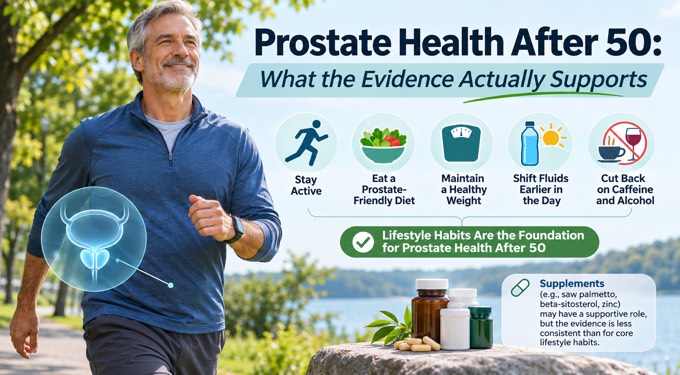
Start with the habits that have data behind them
Before any pill or herb, the strongest evidence points to everyday habits.
Move more. Large observational studies have repeatedly found that physically active men have lower rates of BPH and urinary symptoms than inactive men. You don’t need a gym membership. Regular brisk walking counts.
Watch your waistline. Carrying extra weight around the middle, high blood sugar and other features of metabolic syndrome are linked with a larger prostate and worse urinary symptoms. Anything that improves your metabolic health is likely to help your prostate too.
Time your fluids. Drinking less in the two hours before bed is one of the simplest ways to cut night-time trips to the bathroom. Keep your total daily intake normal; just shift it earlier in the day.
Go easy on caffeine and alcohol. Both can irritate the bladder and increase urgency. Many men notice a difference within a week or two of cutting back, especially in the evening.
Eat more plants. Diets rich in vegetables, fruit, legumes and healthy fats are associated with fewer urinary symptoms in some studies. The evidence isn’t strong enough to call any single food a treatment, but the overall pattern matters and benefits your heart as well.
Try bladder training. Gradually lengthening the time between bathroom visits, and “double voiding” (waiting a moment and trying again before you leave the toilet), are low-cost techniques that urologists often recommend first.
The herbs: what the studies say
Most prostate supplements are built around a handful of plant extracts. Here’s how they hold up.
Saw palmetto. This is the most popular prostate herb, and also the most thoroughly tested. Early, smaller studies looked promising. But when researchers ran larger, well-controlled trials, including a US study that tested doses up to three times the usual amount, saw palmetto did no better than a placebo at improving urinary symptoms. Cochrane reviews that pooled the trials reached a similar conclusion. It appears to be safe for most men, but the best evidence doesn’t show a meaningful benefit.
Pygeum (African plum bark). An older review of trials found that pygeum improved urinary symptoms and flow more than placebo. The catch is that those trials were small, short and often poorly reported. It’s a “maybe,” not a proven option, and wild harvesting has raised sustainability concerns for the tree itself.
Beta-sitosterol. This plant sterol, found in many seeds and nuts, has some of the more encouraging data. A review of short-term trials found improvements in symptom scores and urine flow compared with placebo. Long-term studies are lacking, so we don’t know whether those benefits last.
Stinging nettle root. Nettle is usually studied in combination with other herbs, which makes it hard to know what nettle itself contributes. A few trials suggest modest symptom relief, but the evidence is thin.
Pumpkin seed. Some small studies report symptom improvements, but the research base is limited and of mixed quality.
The pattern is clear: the herbs with the loudest marketing have the weakest results in rigorous trials, while a couple of less famous ingredients show modest, short-term promise. If you do try a supplement, look for one that lists exactly how much of each ingredient it contains. Many products hide their doses behind a “proprietary blend,” which makes it impossible to compare them with the amounts used in research. A product-by-product comparison of prostate formulas and their labels, such as this one from Men’s Health Authority (https://menshealthauthority.
Also tell your clinician about anything you take. Herbs can interact with medications, and some can affect PSA test results.
When it’s time to see a clinician, not buy a supplement
Urinary symptoms are usually caused by BPH, but they can overlap with more serious conditions. Don’t self-treat if you notice any of the following:
– Blood in your urine or semen
– Being unable to urinate, or only passing small dribbles despite a strong urge
– Pain or burning when you urinate, especially with fever or chills
– Symptoms that appear suddenly or get worse quickly
– Ongoing pain in the lower back, hips or pelvis
– Unexplained weight loss or fatigue
Being unable to urinate at all is an emergency and needs same-day care.
Even without red flags, it’s worth getting persistent symptoms checked. A clinician can confirm what’s causing them, rule out infection or other problems, and talk you through options. Today there are effective medications and minimally invasive procedures for BPH that work far better than any supplement for men with moderate to severe symptoms.
Ask about PSA testing, too. Guidelines differ, but most recommend that men in their 50s and 60s make an informed, shared decision with their clinician about whether to be screened, based on their personal and family history.
The bottom line
For most men over 50, the best prostate “supplement” is a set of habits: stay active, keep your weight and blood sugar in check, shift your fluids earlier in the day, and ease up on caffeine and alcohol. Among herbs, beta-sitosterol and pygeum have modest, short-term evidence, while saw palmetto, despite its popularity, has not held up in larger trials. And any warning sign, from blood in the urine to sudden difficulty passing urine, is a reason to see a professional rather than reach for a bottle.
Your prostate changes with age. How you respond to those changes is very much in your hands.
Malkiat Nagi is the editor of Men’s Health Authority.