
By Paul Michael Durivage
A list can make spiritual practice look wonderfully simple. Rosemary means remembrance. Gold belongs to the Sun. Find the right entry, choose the matching object, and the meaning seems settled before you have asked what you need it for.
The useful part begins when you pause over the connection. Who made it? Where did you encounter it? What does it invite you to notice? A correspondence can give you somewhere to begin without deciding what you must believe or what will happen next.
Return the association to its setting
In Act 4, scene 5 of Hamlet, Ophelia says, “There’s rosemary, that’s for remembrance.” Read beside the surrounding speech, the familiar association belongs to a scene filled with grief, flowers and the death of her father. She asks someone to remember; she also speaks of violets that withered when her father died.[1]
This is one literary witness to an association. It does not establish that everyone, everywhere, has understood rosemary in the same way. Nor does a line in a play prove that a plant produces a particular mental or spiritual effect.
What the scene offers is more specific and more human. Remembrance has an object: someone is gone, and someone remains to remember. If you use the association as a reflective prompt, the question might become, “Who am I trying to remember accurately?” That is different from asking an object to do your remembering for you.
You might write down a small detail about a person: a phrase they used, something they taught you, or a kindness you overlooked. You could also notice where affection has softened a difficult memory. The association opens the page. Your attention supplies the particular life upon it.
Notice the reasoning behind the connection
A different example appears in Book One, chapter twenty-three of Heinrich Cornelius Agrippa’s Three Books of Occult Philosophy. In the 1651 English translation, gold appears among the things assigned to the Sun, with its splendour given as a reason for that relationship.[2]
Here the connection belongs to a system of planetary correspondences. It is not the same kind of statement as Ophelia’s speech. Agrippa is arranging natural things within an occult account of the world; Shakespeare is giving words to a character in a drama. Putting their associations on one modern list can hide that difference.
Gold’s brightness can nevertheless become a question for a present-day reader. What am I treating as valuable because it is conspicuous? What quieter thing deserves more care? You need not purchase gold, possess a special object or accept Agrippa’s cosmology to consider those questions. Writing the words “gold” and “Sun” on a page is enough to begin the comparison.
That use is a modern reflection, chosen here. It should not be passed off as an exercise prescribed by Agrippa. Keeping that distinction visible leaves room to learn from an older text without making it responsible for your own additions.
Give your response its own space
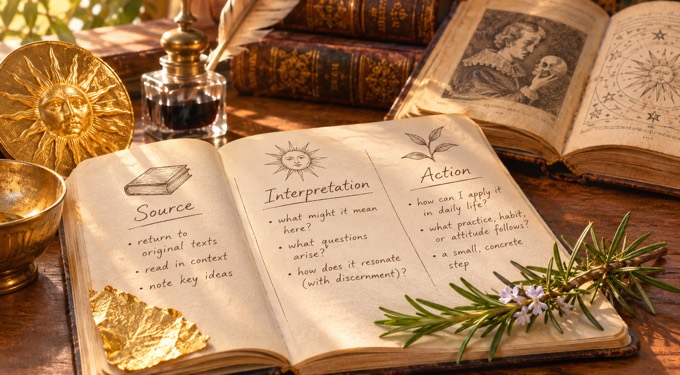
A notebook can help keep three things apart: the source, your interpretation and your action. Record the author and passage first. Then describe the association in ordinary language. Leave a separate space for the question you bring to it today.
For the rosemary example, the source note might identify Hamlet and the scene. The interpretation could concern remembrance within grief. Your own question might concern a person whose story you have reduced to one painful incident. These entries belong together, but they are not interchangeable evidence.
You may find that an association means little to you. Leave that result on the page too. There is no need to manufacture an insight simply because a symbol has a long history or an impressive place in a chart. Perhaps another passage will matter more; perhaps today calls for a straightforward conversation rather than symbolic work.
A useful prompt should allow an unwelcome answer. If the gold question leads you to recognise how much approval governs a decision, resist immediately turning that recognition into a flattering story about growth. Name the actual decision. What would you choose if nobody were there to admire it?
Bring the question back to something ordinary
Reflection gains substance when you can identify what it asks of you. Remembering someone might lead to recording a family story, checking a detail with a relative or contacting a friend. Reconsidering value might lead to giving uninterrupted time to work you keep postponing.
Those are possible responses, not tests that a spiritual practice has succeeded. An honest result may be uncertainty, a more careful question or the discovery that your first interpretation does not fit. You can change your mind without pretending the source has changed with you.
You might keep the page and return to it a week later. Has the question changed? Did you act on the answer, or merely enjoy writing it? A dated note can reveal that difference without requiring you to turn an ordinary event into a message.
This approach lets a correspondence remain open to study. You can appreciate its beauty, examine the setting that gave it meaning and decide how much weight it deserves in your own life. You can also decline to use it.
Before adding the next entry to a list, try staying with one. Find the passage. Read around it. Write a question that matters to you, then give yourself time to answer without arranging the answer in advance.
The association has offered a starting point. What you notice, and what you do with that attention, still requires your judgement.
References
[1] William Shakespeare, Hamlet, Act 4, scene 5, especially Folger text lines 199–209 (FTLN 3098–3108). Folger Shakespeare Library: https://www.folger.edu/
[2] Heinrich Cornelius Agrippa, Three Books of Occult Philosophy, Book One, chapter XXIII, 1651 English translation by J.F., digital transcription by Joseph H. Peterson: https://www.esotericarchives.
About the author
Paul Michael Durivage is a Michigan author of fiction and nonfiction, including The Black Book of Hidden Arts: An Illustrated Guide to Magic, Divination, and Occult Practice.
https://www.