
Source: Laura Wells Research, News, And Astronomy
Laura Wells shares her research on the pole shift: when; what to expect prior to & during shift; safe locations; bug out survival bag; and more.
PLEASE DO YOUR OWN RESEARCH AS WELL! (IT VERY WELL MAY NOT TURN OUT NEARLY AS BAD AS PRESENTED HERE)
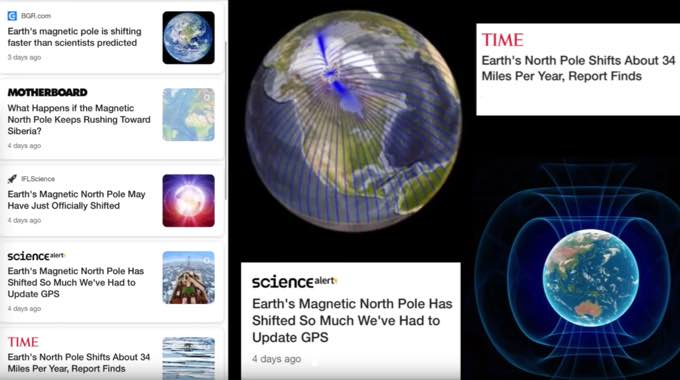
The Earth’s north magnetic pole is now shifting 34 miles per year. That’s 2.8 miles per month (almost 500 feet per day)! It will continue to increase and speed up.
It’s already moving so fast that in about 4 years it will reach its weakest magnetic position. At that point, the pose shift is imminent.
TALKING POINTS IN THIS VIDEO
- Pole Shift and Brown Dwarf – the pole shift is imminent regardless of an approaching brown dwarf. The changing magnetic north has sped up to the point that we can safely say that the pole shift is happening now. It is no longer gradual.
- All geological changes are influenced by the solar system.
- We are literally in the middle of a pole shift and the next 4-5 years are crucial.
- If the sea ice extent trend continues, the Arctic will be ice free in five years. This is due to the Earth heating up both inside and out.
- Signs of impending shift
- 6+ earthquakes in the Atlantic ridge
- If Japan splits and one part goes under
- If Australia’s west coast subsides
- If the internet and power in general shuts down
- If the sun rises in the west
- If any of the above happens, you have 2 weeks to bug out and get to safe locations.
- What to expect during a shift (Mark Elkin – based on 14 years of deep study)
- The oceans will slosh causing 500 foot tidal surges
- The wind will exceed 200 miles per hour
- Huge geological changes – some land will rise up and some will go under water
- Safe locations: in a cave, away from coast, high above ground.
- There are cities that have been found underwater due to the last pole shift
- Ancient Knowledge of the shift/past shifts
- Worst places to be during pole shift
- Middle of the sea in any kind of boat
- By coastal areas
- Near fault lines
- Near volcanoes
- Near rivers
- Near dams
- Near nuclear power plants
- Near cities and towns
- Best places to be during pole shift
- 100 miles from any nuclear power plant
- As far inland as possible
- Nowhere near volcanoes, even dormant ones.
- At least 1200 feet above sea level
- In a cave on solid foundations
- In an underground structure on solid foundatons
- Do NOT trust FEMA or mainstream media news
- Bug Out Survival Bag (tips and help)
- Know your alternative routes